


Mold Remediation Clearance Standards: What S520 Covers and Who Should Verify the Work


Many states operate without formal mold remediation regulations, allowing various individuals to offer these services with varying levels of expertise. Industry standards provide clear protocols to bridge this gap, and the most effective guidelines recommend separating the remediation team from the verification team.
This guide explores the details of the S520 standard, how the National Institutes of Health structures its own program around this separation, and what federal documents state regarding proper testing protocols.
How California Handles Mold Contractor Licensing
California currently operates without state regulations covering mold inspection, assessment, or remediation. Many other states follow this identical approach. Without official licensing, business card titles carry whatever meaning the printer decided to assign.

Industry standards successfully fill that space. A contractor working to a published standard gives you procedures developed by consensus, a highly consistent method, solid documentation supporting your insurance claim, and specific criteria for evaluating the finished work.
While these standards operate completely outside of state law, they provide a highly valuable benchmark. Having this baseline helps you distinguish a carefully considered project from a confident guess.
What the S520 Standard Covers
The American National Standards Institute and the Institute of Inspection, Cleaning and Restoration Certification (ANSI/IICRC) S520, Standard for Professional Mold Remediation, serves as a voluntary consensus standard currently in its fourth edition. It covers assessment and documentation, containment and worker safety, cleaning and removal methods by material type, completion evaluation, and communication protocols.
Source removal remains the absolute top priority. The central principle establishes that physically removing contamination serves as the primary means of remediation, with chemical treatments serving only as a supplemental step. This approach matters immensely because dormant mold fragments still contain allergens and irritants. Treating growth without physical removal leaves those irritating materials lingering in the home.

The National Institutes of Health reaches the identical conclusion in its own operating procedures. Physical removal remains the primary means of remediation, and remaining fragments stay allergenic long after the mold becomes non-viable.
Regarding the role of biocides, the National Institutes of Health states that biocide use falls outside their routine recommendations during remediation. These chemicals pose toxicity risks to humans alongside molds, leading the agency to generally avoid them. A contractor proposing a plan centered entirely on spraying, fogging, or bleach solutions operates far outside the methods outlined in these professional standards.
Following the S520 standard guarantees a specific procedural approach rather than promising a specific medical or building outcome. Anyone presenting it as a formal statute or a license misrepresents its true purpose.
Conditions 1, 2, and 3
The S520 standard classifies an inspector's observations into three distinct conditions. These classifications describe the physical project rather than assigning health-risk grades or legal thresholds.
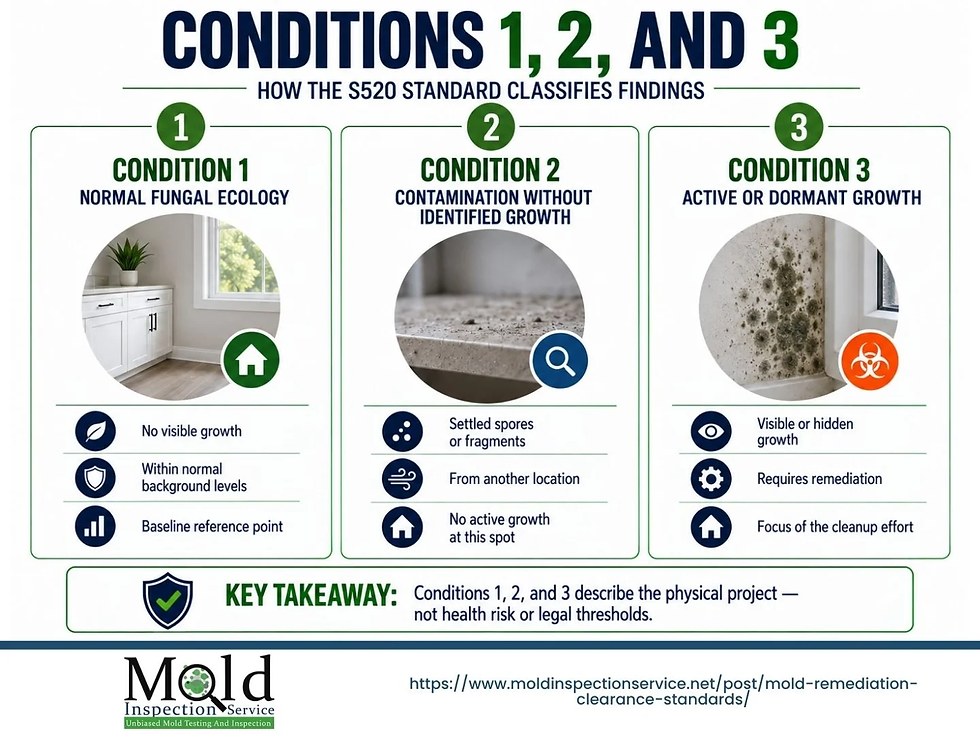
Condition 1 represents normal fungal ecology. This describes an indoor environment showing zero evidence of growth beyond normal background levels. This serves as a baseline reference point rather than a promise of zero spores.
Condition 2 signifies contamination without identified growth. This condition involves settled spores or fragments arriving from another location, resting on surfaces or in the air, lacking an active colony in that specific spot.
Condition 3 points to active or dormant growth, whether visible or hidden. Remediation efforts focus directly on this third condition.
A highly defensible project maps the Condition 3 areas, accounts for Condition 2 contamination surrounding them, corrects the moisture source, and establishes a clear mold remediation protocol for the cleaning and removal process. Our comprehensive mold inspection in Sacramento produces exactly that detailed map.
How the National Institutes of Health Separates the Work
A clear example of project independence is how the National Institutes of Health manages its facilities. The NIH Moisture and Mold Remediation Standard Operating Procedures assigns specific tasks to two completely distinct divisions.
The Office of Research Facilities Development and Operations identifies and fixes the water source, handling the water removal and restorative drying process. Separately, the Division of Occupational Health and Safety walks the affected area, collects environmental data, evaluates suspected growth, recommends the remediation approach, and assesses conditions for occupancy following the project's completion.

The facilities division must notify the health and safety division whenever the affected area exceeds ten contiguous square feet, whenever the water originates from a non-sanitary source, and immediately upon finding any suspected growth. This structure ensures the division fixing the building remains entirely separate from the division verifying the success of the repair.
This independent structure mirrors our approach. We provide unbiased mold testing and moisture assessments for Sacramento homeowners. We assess, document, and verify the project, leaving the physical removal to a separate contractor of your choosing.
What S520 Says About Independence
Stating this precisely remains important, as many professionals overstate these guidelines. The S520 standard recommends considering the separation of assessment and verification from the remediation contractor on projects that are large, complex, disputed, or highly sensitive to an insurance claim. It describes independence as a project-by-project decision rather than a universal requirement.
Some states take this guideline further. Texas prohibits a license holder from performing both assessment and remediation at the identical property. Florida issues separate licenses for assessors and remediators. California leaves that decision entirely to the property owner, giving you the power to choose your preferred arrangement.
What the NIH and the CDC Say About Testing
Understanding three federal positions helps you evaluate testing recommendations.
First, sampling often provides minimal additional value. The National Institutes of Health states that sampling for mold frequently proves unnecessary when you already have visible signs or musty odors. They advise pursuing sampling strictly following a highly defined strategy.
Second, the industry operates without established exposure standards. The National Institutes of Health confirms that the Occupational Safety and Health Administration and other agencies operate without set occupational exposure levels for mold. Therefore, sampling alone cannot check a building against existing standards. The Centers for Disease Control and Prevention adds that short-term air sample concentrations lack the ability to predict health risks.

Finally, verification relies heavily on direct observation. The National Institutes of Health defines a remediated area as clean when contractors remove all contaminated and unrestorable materials, leaving surfaces visibly free of dust and the area completely free of odors. Sampling is noticeably absent from that definition.
We share this information as a company providing professional mold testing services. Sampling earns its place when it answers a specific question, when an insurer requires it, or when the moisture source remains hidden following a thorough inspection. It serves as a supplement to the visual assessment rather than a replacement.
Certifications Worth Asking About
Professional credentials showcase education, examination, or experience. Verifying these credentials with the issuing body ensures you hire a highly qualified team.
Remediation credentials include the Institute of Inspection, Cleaning and Restoration Certification (IICRC) Applied Microbial Remediation Technician and Mold Remediation Specialist designations. You might also see the American Council for Accredited Certification (ACAC) Council-certified Microbial Remediator and Remediation Supervisor titles.
Assessment credentials include the ACAC Council-certified Microbial Investigator and Microbial Consultant designations.
The distinct split between those two lists highlights a major industry point. Organizations treat assessment and remediation as separate disciplines requiring completely different qualifications.
Red Flags When Choosing a Remediation Contractor
Exercise caution with a contractor who does any of the following:
Relies heavily on chemical sprays, foggers, or mold bombs while excluding physical material removal from their plan.
Lacks a thorough explanation of their work area containment strategies.
Provides an oral agreement without a detailed written scope of work.
Guarantees mold-free results, an impossible feat given that spores exist naturally in every environment.
Uses fear-based language regarding toxic black mold to pressure a rapid decision.
Struggles to produce proof of training, certification, or insurance.
Excludes the underlying moisture source repair from the project scope.
Declines to discuss independent verification on a project perfectly suited for it.
Describes the S520 standard as state law or promises specific medical outcomes.

Frequently Asked Questions
Is S520 a Law?
The S520 serves as a voluntary consensus standard. Following it represents an industry best practice rather than a legal requirement or a guarantee of a specific outcome.
Should the Same Company Remediate and Verify?
The S520 recommends considering separation on large, complex, or disputed projects. Texas and Florida prohibit the combined arrangement by law. California leaves the choice to you.
Do You Perform Remediation?
Mold Inspection Service of Sacramento specializes exclusively in inspecting, testing, and reporting. You simply take our findings to whichever contractor you choose, and we gladly verify their finished work upon completion.
What Does Post-Remediation Verification Check?
This process verifies the successful removal of contaminated materials, confirms surfaces remain visibly dust-free, ensures the area smells fresh, and confirms the repair of the moisture source. Clearance testing adds strategic sampling when the project requires it.
Can a Contractor Guarantee My Home Is Mold-Free?
Mold spores exist naturally in every building. Because spores are microscopic and naturally occurring, treating any '100% mold-free' promise as a warning sign helps you choose an honest professional.
Is Bleach an Acceptable Remediation Method?
Federal guidance leans away from bleach as a primary approach. The National Institutes of Health states that biocides carry toxicity risks for humans alongside mold, leading them to avoid routine recommendations. Physical removal remains the primary means of successful remediation.
Secure Your Unbiased Mold Assessment Today
Mold Inspection Service of Sacramento provides professional inspection, testing, and reporting across Sacramento County, El Dorado County, and Placer County. You can view our complete coverage map on our service areas page.
By avoiding remediation work entirely, our team maintains complete objectivity. This independence allows us to assess the work another contractor performed and tell you honestly whether it meets the highest professional standards.
Get in touch with our team to arrange your initial assessment or post-remediation verification today.
Comments