


Air Sampling vs Surface Sampling: Which One You Need, and When You Need Neither

Updated: Sep 28

An air sample measures the particles floating in a room, while a surface sample identifies the material growing on a specific spot. Understanding how these tests work helps you choose the most effective approach for your home. This guide explains the purpose of each method, covers what the federal agencies say about their limits, and shows when a thorough visual inspection carries the most value.

A Quick Overview of Sampling Methods
An air sample pulls a measured volume of room air through a collection cassette. Following the collection, the laboratory counts and identifies the captured spores. This method serves as the primary tool for investigating suspected hidden growth.
A surface sample lifts material from a specific spot using tape, a swab, or a cut piece of the material itself. The laboratory then analyzes the sample to identify the species present. This option suits visible growth.
Feature | Air sample | Surface sample |
What it collects | Airborne particles during the sampling interval | Material from one chosen location |
What it answers | The contents of the air during those specific minutes | The composition of the specific patch |
Target requirement | Works without a visible target | Requires a visible area to sample |
Primary constraint | A short snapshot, sensitive to weather and air handler activity | Describes the selected spot and nothing beyond it |
Professionals always analyze these results within a broader context. An indoor air sample requires a simultaneous outdoor control sample taken at the same property. Since mold spores exist naturally outdoors, comparing the two samples is what shows whether the indoor environment reads differently.
What You Can Learn From an Air Sample
A spore trap captures the airborne particles present during a brief collection window. Spore counts fluctuate based on the daily weather, open doors, air conditioning cycles, and foot traffic in the room. Two samples taken in the same room on different days will frequently show varying results.
The Centers for Disease Control and Prevention is direct about what that means. Measured mold concentrations from short-term air samples cannot be interpreted in relation to health risks, and no established health-based standards exist for acceptable levels of biological agents in indoor air.

An air sample produces environmental data. A laboratory reporting spores per cubic meter is reporting what the cassette collected, not delivering a verdict on the building or on anyone in it.
What the sample does reveal is how the indoor air compares to the outdoor air on that specific day, and whether water-indicator species are present inside and absent outside. That's a useful environmental signal about the property.
What You Can Learn From a Surface Sample
A surface sample provides highly accurate answers to a narrow set of questions.
Tape lift. The inspector presses transparent tape to a visible spot and lifts it away. This preserves the structure for the laboratory to examine under a microscope, and it's the standard approach for a discrete patch.
Swab. The inspector rubs a sterile swab across a suspect area. This suits textured or porous surfaces that need an alternative to the tape method.
Bulk. The inspector collects a small piece of the material itself. This helps determine how deeply the growth has penetrated the surface.
All three confirm details that fall outside the scope of an air sample. First, they verify the composition of the discoloration, distinguishing biological growth from soot, mildew, or ordinary dirt. Second, they identify the species present, which helps trace the growth back to particular conditions and moisture sources.
Surface sampling relies entirely on having visible, accessible growth to collect a proper specimen. Where the growth sits behind a wall or under a floor, there's nothing to press tape against.
How the CDC, NIOSH, and the EPA View Sampling
Reviewing the federal guidelines helps you direct your testing budget.
The National Institute for Occupational Safety and Health states that thorough visual inspections and detecting problem areas by musty odors are more reliable than air sampling for mold. NIOSH does not recommend routine air sampling for building air quality evaluations.
NIOSH built a complete assessment method on that finding. The Dampness and Mold Assessment Tool scores dampness and mold damage room by room. It evaluates ceilings, walls, windows, floors, furnishings, ventilation systems, and pipes by observing visible water damage, visible growth, wetness, and mold odor. The tool collects no environmental samples at all.

The Environmental Protection Agency reaches a similar place from another direction. Sampling is usually unnecessary where growth is visible, and fixing the underlying moisture problem is what allows any cleanup to be considered finished.
This does not make sampling useless. It simply means a thorough visual inspection should guide the process, with sampling used to answer specific questions that arise during the assessment.
When to Invest in Professional Testing
Sampling earns its cost when you need data beyond the findings of a visual and moisture inspection.
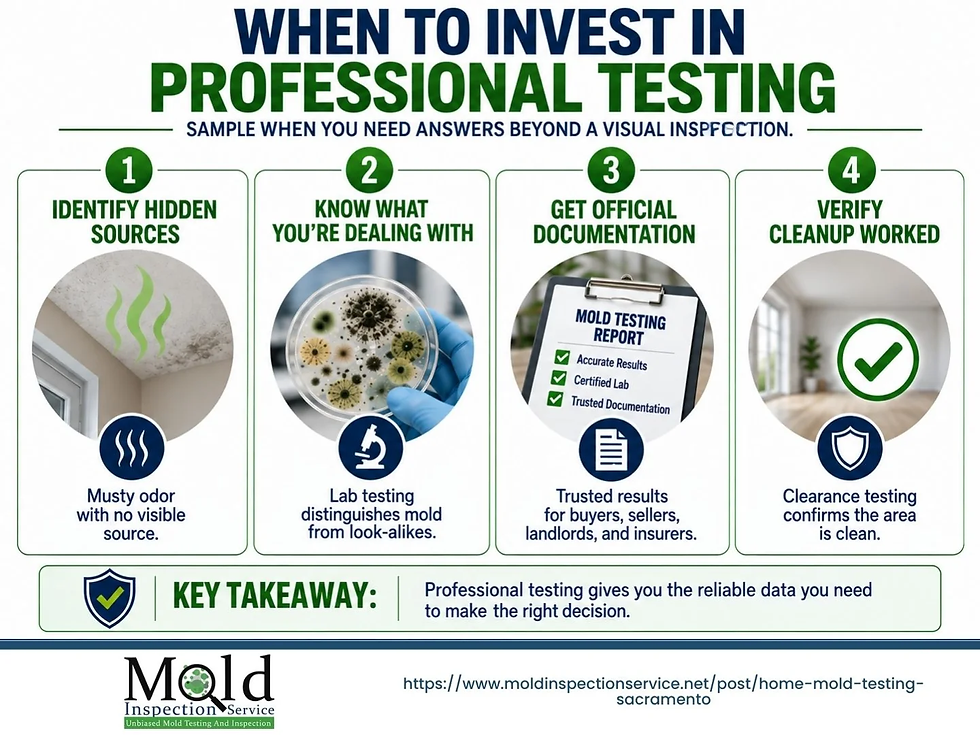
Identifying hidden sources. A musty odor with no visible source presents the strongest case for air sampling, since the spore trap needs no target.
Classifying a visible patch. Soot, mildew, and mold often look identical to the naked eye and are distinguishable in a laboratory.
Providing official documentation. Landlords, buyers, sellers, and insurers frequently request formal documentation, and a certified laboratory report supplies the authoritative data those transactions need.
Verifying completed remediation. Clearance testing after a remediation project is the case where sampling matters most, and where it has to come from a company that didn't perform the work.
When to Rely Solely on a Visual Inspection
Not every situation requires a lab sample. Here are three scenarios where a visual inspection provides all the direction you need.
Visible growth from a known source. Growth on a wall below a known leak provides plenty of actionable information already. Putting the budget into fixing the moisture yields a better result.
Looking for a number that says safe. That number doesn't exist. Federal guidance states plainly that no health-based standards have been established for mold in indoor air.
Sampling out of worry with no question attached. Samples work when paired with a specific goal. Defining the objective first is what makes the result worth the cost.

We say this as a company that provides testing services. Mold Inspection Service of Sacramento inspects, tests, and reports, leaving remediation entirely to other contractors. Because we have no financial stake in finding a problem to fix, we have no reason to sell you a sample you don't need.
How the Sacramento Climate Impacts Moisture
Local environmental conditions shape where moisture accumulates, which makes regional knowledge valuable during an inspection.

Winter saturation. Sacramento sits at the confluence of two rivers. Floodplain soil in areas like Natomas and Little Pocket holds water for weeks following an atmospheric river. That moisture wicks upward into crawlspaces and condenses on floor joists, where physical observation is what finds it.
Summer condensation. Rapid Central Valley temperature swings push warm, humid air against cold duct surfaces. Older housing stock frequently has looser duct seals, creating spaces where water collects out of sight.
Older building envelopes. Homes in Curtis Park, Land Park, and Midtown often predate modern vapor barriers, so moisture moves through those wall assemblies more freely than it does in newer construction out toward Elk Grove or Roseville.
Inspectors locate these conditions using visual assessment, moisture meters, and thermal imaging. A cassette in the living room finds none of them.

Frequently Asked Questions
Should I Get Air or Surface Sampling?
Choose surface sampling when you want to identify a visible patch of material. Choose air sampling when investigating a hidden source. Both together provide the documentation a landlord, a buyer, or an insurer is looking for.
Can a Mold Test Tell Me if My Home Is Safe?
No. No established health-based standards exist for mold in indoor air, and federal guidance states that short-term air sample concentrations cannot be interpreted in relation to health risk. A test reports environmental conditions.
Why Do You Take an Outdoor Sample Too?
Mold spores exist naturally in every outdoor environment. Collecting a same-day outdoor comparison sample provides the baseline needed to interpret the indoor readings.
Do I Need a Test if I Can Already See Mold?
Often not. Where growth is visible and the moisture source is known, you can prioritize fixing the water and removing the affected material. Testing offers the most value when you need laboratory identification to guide the next step.
Are DIY Kits Worth It?
DIY kits confirm the presence of spores, which exist naturally in almost every home. Professional mold testing adds the direct comparison to outdoor air, the species identification, and the analysis of where the moisture came from.
Do You Do the Remediation Too?
No. Mold Inspection Service of Sacramento focuses on inspecting, testing, and reporting. You take our report to the remediation contractor of your choice.
Schedule Your Professional Assessment Today
Mold Inspection Service of Sacramento provides mold inspection, testing, and reporting across Sacramento, Folsom, Placerville, Cameron Park, and surrounding areas.
Our team helps you work out the testing approach your property needs, and sometimes the answer is no testing at all. Contact us to talk through your situation.
Comments